Thursday, April 26, 2012

Blog#6


1. I interviewed Dr.Puche She studies Biological Sciences & She currently works at  University of Illinois at Chicago as a Adjunct Assistant Professor
2.    Dr.Puche is a reliable because she studies biological sciences & she would know about genetics because she studies things like this for a living.
3.      I called Dr.Puche & i interveiwed her on 
  • What roles does Dna play?
  • What roles does Genes play?
  • How doe you get skin cancer?
  • How can you prevent skin cancer?

Part A
1. I emailed my cousin (Alex) to find out information about the Mayans and Aztecs.
Back in his highschool he toke a class on the Mayans and Aztecs. His job is an
accountant.
2. He is a reliable source because he studied the Mayans and Aztecs.
3. I emailed him to get information on the Mayans and Aztecs, I emailed him 4/26/2012

Part B
  • I asked him background knowledge on them.
  • I asked what their culture was like.
  • I asked what kind of religions did they have.

Blog Post #7

Title: Natural Australia (website)

http://www.australia.com/explore/things-to-do/natural-australia.aspx?channel=paid-search&campaign=us-local-fy2012-project167-167-nature-aus&message=brand&publisher=yahoo&adgroup=wildlife(phrase)&keyword=animals%20of%20australia&matchtype=phrase

Author: Curtis Falls

This website is reliable because it was updated in 2012, and there are many corporate links associated with the website.

1. 2012
2. Curtis Falls, and Tourism Queensland
3. It conects to other websites to show proof and expand more on the information they use


#6 -importing interview

BLOG POST #6
My Interview
 
PART A
1.  I interviewed my trainer for hunter jumper, equitation, and jumper riding.  She teaches at my AA circut barn 5 days a week.  She has done it since she was 18 years old and knows everything there is to know about horses.
2.  She has been around horses since she was younger then 18 and has los of experience when it comes to teaching.
3.  I interviewed her through text on April 12, 2012.
 
PART B
1.  How do you find the horses from Europe?
Answer: We have a contact that arranges for us to go visit a number of different farms so we can see their sale horses
 
2.  How do you find the right one?
Answwer:  We determine which horse to buy, by the ability of the horse, ability of the rider, size of the horse, its bloodlines, experience of the horse, and your price range.
 
3. How many do you usually try when you go to Europe?
Answer: Ususally we try around 40 horses minimum per trip and narrow it down to the top 3.  We then go to ride the horses again and decide which one to have the vet do an exam on the begin the importing process.
 
3.  How much does it cost to fly them here?
Answer: For a gelding it costs $5,000, for a mare it is $7,000, and for a stallion it costs $10,000.
 
4.  How long do they stay in quarentine?
Answer: The quarentine station that we use is in New York.  The geldings are only required to stay for 3 days.  The mares and stallion have to stay for a week.
 

Horse Classification

There are more horse breeds than we can count, but there are only three classifications that horses fall into: cold blood, warm blood, and hot blood.  The differences in the horses in each classification are as follows:
1.       Cold Blood: Horses that are classified as cold bloods are a big muscular draft horses that are born and bred as work horses to pull heavy loads or plow fields.  An example would be the Clydesdale.
2.       Hot Blood: Horses that are classified as hot blooded are born and bred for speed. There are only five breeds of horses that are classified as “hot blooded.” They are as follows: (1) the Akhal-Teke; (2) the Barb; (30 the Turkoman (now extinct); (4) the Arabian; and (5) the Thoroughbred.  Hot bloods are highly intelligent horses.  They learn quickly and they are naturally athletic and versatile.  You are probably most familiar with the hot blood Arabian horse and the hot blood Thoroughbred horse.
3.       Warm Blood: Originally the term “warm blood horse” meant that the horse was a cross between a cold blood (draft) horse and a hot blood (one of five breeds) horse.  Accordingly, the warm blood breeds got started when European carriage and war horses were crossed with Arabian of Thoroughbreds.  The result was a tall riding horse that had more refinement that a draft horse, but was larger, more durable and had a more easy-going temperament than a hot blood.  Today, there are actually tow different meanings of “warm blood horse.” The first meaning refers to a specific subset of horse breeds, the second meaning refers to horses that have a moderate temperament.

Thursday, April 19, 2012

the killings of dolphins in japan

In this movie, Richard O' Barry explains that the Japanesse in Taiji have constructed a secert cove to murder dolphins and sell them for meat. Normally you would think that this isint a big deal because we do the same thing with fish and cows and other animals. But dolphins have been becoming endangered because of the killings and scientist have found larg amounts of mercury in the dolphin meat, which is a problem because mercury can make you have a deasiese where you lose your eye sight and hearing. Another problem is that the people killing the dolphins say that its their culture and that they cant stop the killings. This relates to what we are currently learning in world clutures today, about the Huarani people and how the Ecuadorians wanna drill for oil in their rainforrest and the Haurani people dont wont them there and dont want the missionaires there ethier. But the reason why the missionaires are there is because they need to teach the Haurani to be clivilized people. You see, the Haurani people barely wear any clothes and they are still living in the Stone Age, and the missionaires are there to help them be civilized. The haurani have a right to say no because its their culture and not someone else, just like how its the Japanesses culutre and not the Americans.

Monday, April 9, 2012

How Genes Are Passed On?

In this book,Genetics,Richard Beatty explains What genes are and How Genes are passed on.One fact that supports this main idea is A basic feature of all life is that cells divide to make more cells.Another  fact that supports this main idea is A single cell divides to form two offspring cells. This is how single-celled life forms such as bactria reproduce. Finally, the author gives an example that It is also how larger, more complicated life forms such as ourselves grow & develope to support the main idea. This ideas are similar to the main idea of how genes are passed on because they all are refferences of how they are passed on to there offsprings & also how we ourselves grow & develope.

  • Cells divide
  • The chromosomes spread apart to create another unique cell
  • The parents have 48 chromosome but they give away 24 each to create there offsprings talents etc.
  • Cells divide to make more cells

Monday, April 2, 2012

Global Warming-book


    AN INCONVENIENT TRUTH
    -book not divided by chapters, it is divided by sections & i read 4 sections.
     
    In this book, Al Gore explains that global warming is a serious issue and that there are many things humans need to do to put an end to it.
    One fact that supports this main idea is that the thin layer of atmosphere is being thickened by huge quantities of human-caused carbon dioxide and other greenhouse gases. And as it thickens, it traps a lot of infrared radiation that would otherwise escape the atmosphere and continue out to the universe. As a result, the temperature of the Earth's atmosphere and oceans is getting dangerously warmer. Another example that supports this main idea is this quote "Our own Glacier National Park will soon need to be named 'the park formerly known as glacier'." this quote really shows how global warming really is effecting the world and things inside it. Finally, the author gives all the reasons why we need to pay more attention to this global issue and what things everyday people can do to put an end to the warming of our climate. All of the pictures and explanations provided helped to support the main idea.
    These ideas are similar to what we learned in biology class because we learned about evolution and the temperature of the earth.

1.) glaciers are melting
2.) our new technologies, combined with our numbers, have made us collectively a force of nature
3.) the entire Aral sea is now essentially, gone.
4.) when we divert too much water without regard for nature, rivers sometimes no longer reach the sea.
5.) irrigation has long worked wonders for humankind. But we have the power to divert giant rivers according to our design instead of nature's.
6.) old habits+old technology= predictable consequences 
     old habits+new technology= dramatically altered consequences
7.) we are witnessing an unprecedented and massive collision between our civilization and the earth.

Friday, March 23, 2012

The Japanesse Killing of Dolpins

In the article i found online http://savejapandolphins.org/blog/post/taiji-culture I had found interesting information that i hadnt yet discovered about the Japanesse killing of dolphines.
#1: I think one of the most difficult things one can do is to understand someone else's world-view, especially when there are so few common denominators.  And so I'm wondering why the Taiji fishermen who live in a town that appears to have an almost whimsical view of marine mammals can kill them in ways that appear to be objectively cruel.  - Thats my 1st question why the Taiji fishermen who live in a town that appears to have almost whimsical view of marine mammals can kill them in ways that appear to be objectively cruel.

#2:I'll probably never understand their perspective, and vice versa.  As an observer, though, I think it's important to keep cultural differences in perspective.  I could argue that the fishermen are unconscionably cruel, but I won't.  If I did, they'd certainly reply that Westerners who raise hundreds of millions of intelligent animals like pigs in horrific factory farms then kill them in secret facilities are in no position to lecture them on humane treatment of animals and transparency. - My 2nd question is that the Japanesse might kill dolphins but we Americans also kill chicken, fish, and all sorts of things. What im saying is why are we ( Americans) upset about them killing solphins when we kill chicken, fish, cow and other animals for a source of food everyday?

#3:
There is, however, one significant difference that transcends cultural differences.  The dolphin meat the Taiji fishermen sell to their fellow citizens contains alarmingly high levels of mercury.  Knowingly poisoning their fellow citizen is unconscionable, especially in a country where the dangers of mercury poisoning are almost universally recognized. - This part  kinda answers my question to #2 but it also starts another question that i would like to explore more about. If dolphin meat contains high level of mercury in it why would the fishermen want to sell it to their fellow citizens knowing that it could posion them. This question also makes me want to explore what is it like to get mercury posioning.

4- some interesting thing i have already learned about this topic so far is that, Taiji is known for mercury posioning their town. I already knwo that the Japanesse have killed whale meat before and i would like to explore why they killed whales also. They also kept this a secert, they didnt let anyone watch the dolphin killings yet the government knew it was happening.

5- The japanesses argument was that it was their cluture to kill these dolphins and that the Americans can't really do anything about that cause we cant take their culture away from them.

6- Our next argument about these killings was that the mercury posioning inside it. Mercury posioning can ruin your life and it is very bad for you if you may get it.

7- Right now, every year ( i forget which date it is on) thosands or maybe millions of dolphins get killed each year. And i have noticed online that their are support groups to stop it.

8- In the article, I read this --  The public is told that whale and dolphin populations are healthy and that harvests are conducted “scientifically.”  It is nonsense, but unless you live outside of Japan where you can learn the truth, you are stuck with a false sense of reality.-- this kinda tells me something about whales that will help me on my project.

9- I think that the Japanesse also harvest whales for selling in stores or eating. I would like to find out if whale meat is also high in mercury as well as dolphin meat.

10- I know that the Japanesse people needed to know the truth about these killings and when eating a dolphin how it can really hurt you. In the article-- It is up to us to tell the Japanese people the truth.  Many of them are truly afraid of their government and certainly do not realize the squalor and the brutality of marine mammal hunts-- talks about people needing to know the truth and in the movie the Cove they do just that.

Thursday, March 22, 2012

Dutch and Thoroughbred Breeds


Horse and Pony Encyclopedia: By: Sandy Ransford
Chapter, Warmbloods, Hotbloods

  • Dutch Warmblood-Show Jumper
  • Thoroughbred-Stamina, Show Jumper
  • Holsteiner- Show Jumper
  • Hanoverian- Popular for Dressage
  • Certain horses are bred for certain things
  • Ethnicity of many horses
  • What to look for when you are buying a horse
     In this Book(book/article, etc.), Sandy Ransford (author) explains (claims/argues/explains), that Dutch Warm Bloods and Thouroughbreds are the main breeds known to be the best for jumpers. (identify author’s argument/purpose).
    One reason/fact/example that supports this main idea is the reason that they have the ability to obtain stamina in order to go around the course.  Another reason/fact/example that supports this main idea is that they way that these two horses are built helps they excel at show jumping and doing hunters.  Finally, the author gives the reason/fact/example that because of where they were originally bred it is what they have evolved to do well in to support the main idea.
    These ideas are connected (connected/similar) to my life because I do jumping as my type of riding and the main horses at my barn are Dutch Warmbloods and Thoroughbreds. (something you learned or experienced previously) _

Einsiedler

The Encyclopedia of the Horse
Elmyn Hartley Edwards


  •  In the 19th century, the Swiss army relied heavily on imported horses.
  • The Einsiedler was the first bred horse of Switzerland. 
  • The most important blood lines were the ones established by the Anglo-Norman horses. 
  • Anglo-Norman horses led to the Einsiedler. 
  • The Einsiedler is a large, calm, well made horse. 
  • A horse very suitable for various types of performance riding. 
  • They are also often used for harness driving.  


    In this __Book____________________________ (book/article, etc.), _____Elmyn H. Edwards______________ (author)   ____explains__________(claims/argues/explains) that __that the Einsiedler horse is a Swiss horse, that can be tracked back nearly 1,000 years to the Benedictine monastery of Einsiedeln, the origin of where the horse got their name. ______________________
    ______________________________________________________________________________________ (identify author’s argument/purpose).
    One reason/fact/example that supports this main idea is ____The Einsiedler is also known as the Swiss Warmblood.  It gets that name because it is from Switzerland, in the Swiss country side. ___________________
    ___________________________. Another reason/fact/example that supports this main idea is ________________________________
    These horses are among the most important blood lines for the rest of the Swiss horses.  All other Swiss horses are decedents of the Einsiedler.____________________________________________________________________________________________________________________________. Finally, the author gives the reason/fact/example ______of how several warm-blood horses are bred of the same blood line from the Einsiedler. ___________________________________ to support the main idea.
    These ideas are connected (connected/similar) to ________________every other horse bloodline______________________________ (something you learned or experienced previously) because ________________________all horses in one region or area are all related, or descendants of each other. ____________________________________________________________________________ (explanation of connection).
AUTHOR: Michelle Lister.
TITLE: Understanding People In The Past, The Aztecs.
PAGES READ: 1-19

  • Believe Gods lived in layers in heaven, ones on top layer were most important.
  • Believed you live on after you die.
  • They worshiped many gods.
  • Two main things the kids learned at school, fighting and farming.
  • Girls did not go to school.
  • Aztecs buried dead bodies or cremation.
  • Hold funerals/ceremonies when somebody dies.
  • Beliefs much like Hinduism, how they do in this life effects the next.
  • Aztecs believed blood was needed to sacrifice in order for sun to shine.

 In this book Michelle Lister explains the Aztecs life, how they lived what they believed in. One fact that supports this main idea is that she said Aztecs believed blood was needed to sacrifice in order for the sun to shine. Finally, the author states all of the different gods they believed in. These ideas are similar to that of the Mayans cause they also believed in some sacrifices and different gods.

Tuesday, March 20, 2012

Find a Book

Title: The Year of the Koala
Author: H.D. Williamson

Important Notes:
  • Koalas are nocturnal
  • Koalas are found in the eastern coastal area, which is the most heavily populated
  • Koalas rest on thin branches
  • Her fur is either misty gray or dark brown in shadows
  • Koalas prefer to stay separated
  • They keep their babies in a pouch, when first born, much like a kangaroo
  • The population of Koalas has decreased over the years

Summary:

In this book, Williamson explains that Koalas are a very important and interesting part of Australia. One example that supports this idea is that he explains how the Koala population has decreased due to hunting for their fur, and how it needs to be stopped. Another reason that supports the main idea is that the inhabit in a heavily populated area, an an area that is so prosperous in Australia. Finally the author gives the example of how their life may be boring filled with sleeping/eating, yet they are very diverse animals. These ideas are similar to slavery because the Koalas mind their own buisness, and they are used for profit.

Monday, March 19, 2012

How does Genetics affect life?

http://learn.genetics.utah.edu/content/begin/traits/
Heredity & Traits

  • The passing of traits from parents to child is the basis of heredity
  • Everybody has thousands & thousands of genes
  • Genes may specify your certain hair color
  • Humans have 2 sets of 24 chromosomes
  • Every child receives half of its chromosomes from its mother & half from it's father
  • Each parent contributes one complete set of chromosomes to the child
  • Traits are passed from different generation to generation, we inherit traits from our parents  & then they are transferred down to the children's children to continue the cycle.
  1. What is the true definition of a trait?
  2. What kinds of traits are there?
  3. Can several traits be passed down?
  4. Can a trait skip over a child?

Volcanoes- THE SEA


  •  Hawaii's largest volcano has been erupting frequently since 1983 adding an extra 200 acres of land to Hawaii.
  • The Galapagos islands were actually built off the deep sea volcanoes
  • They grew to be so tall, that they ended up crashing down to the sea.
  • Volcanic activity can cause an earthquake depending on the amount of magma being pumped into the ocean.
  • Volcanic activity will end up eating up and renewing the ocean floor
  • Volcanoes can create a deep sea desert, large vast amounts of ocean floor.
  • 80 % of volcanoes on earth are found underwater
  • Volcanoes proven to be one of the major theories of life evolution.


Realms of The Sea: Mary B. Dickinson
Publisher: National Geographic Company


Chapter 2: Deep Ocean, helped me on my research because it provided additional information about volcanic eruptions that help the environment under the water.  One thing I learned from reading this chapter in the book was that, some habitats are provided to special types of shrimp that thrive off the environment.  The chapter was mainly about types of species that live in the deep sea, and mentioned little about volcanoes.  I didn't find this book helpful to me because I felt that it lacked important information that I could have used.  

Thursday, March 8, 2012

Dutch Warmblood

http://search.proquest.com/docview/413853439/1355842F77B649F4F3A/2?accountid=6222
ProQuest Platinum
Horse and a dream stalled by epidemic Foot-and-mouth disease keeps Woodstock woman from importing a stallion to pursue Olympic hope


Dutch Warmblood
Cost:35,000-75,000
Dicipline: Dressage
Orgin: Holland

The Usual
Boarding: $500
Lessons: $200 per package
Shoes: $400 (all 4)
Grooming: $150

-Surgical Nurse Martha bought a Dutch Warmblood in Holland
- There was a Dutch Warmblood horseshow one day
-Martha has the horse on layaway
- She wants to train for the olympics
- The horses' name is Rafel
- The horse is under quarentine because it got sick with Hoof and Mouth Disease
- Because of Hoot and Mouth, nearly half-million livestock had to be killed to prevent the disease
- Hoof and mouth is deadly to humans, not livestock
- The horse is still under quarantine.
- Martha still hopes to go to the 2008 Olympics.
- She knows that Rafael can get her there. She just doesn't know when.


Log 4, Keeping a Horse

The cost of keeping a horse:

Per Month:
  • Boarding cost: which include... feeding, turnout, shoeing: $800
  • Training rides: $180
  • Medicine: $50
  • Lessons: $360
  • Body Clipping: $400

Google Images

Sunday, March 4, 2012

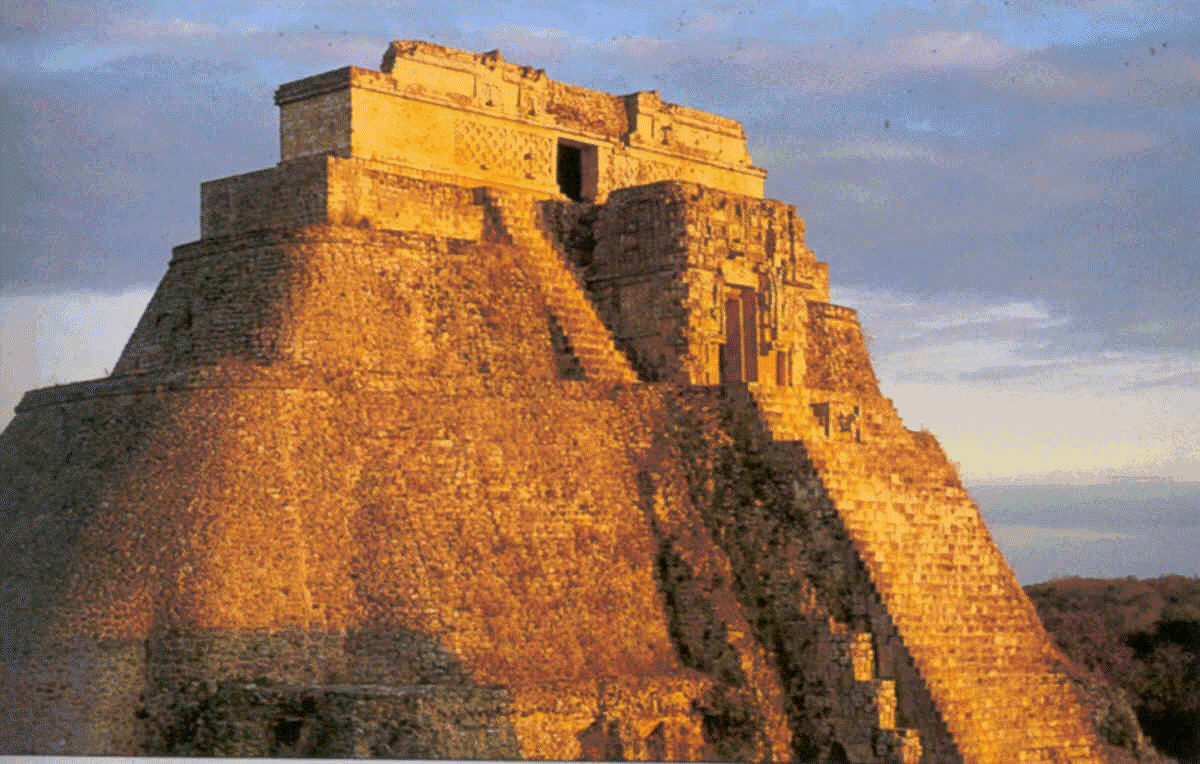
MAYAN/AZTEC BUILDINGS

Mayans Buildings. Digital image. WPMU DEV -The WordPress Experts., 12 May 2010. Web. Mar.-Apr. 2012. <http://vanduzera.edublogs.org/files/2010/05/Mayan-Temple.gif>.


  •  Mayans buildings were made on limestone, the first largest pyramid built by the Mayans was made between 400 B.C and 600 B.C.
  • Roof Combs made Mayan buildings seem taller.
  • Carvings on Mayan buildings were called Frezies.
  • Mayans used stone tools to carve the buildings instead of metal.
  • Mayan temples were used for religious reasons, same with Aztecs, they are still used religiously today.
  • Main reason for Aztecs making the pyramids was to honor their gods.
  • Three types of Aztec pyramids, twin stair, round layer and later pyramids.
  • Most pyramids of the Aztecs are found in Mexico today.

  1.  What type of religion did the Mayans and Aztecs follow?
  2. How are they practiced?


Friday, March 2, 2012

How To Stop Global Warming

WHAT IS PREVENTING US FROM STOPPING GLOBAL WARMING?
 AND HOW CAN WE PUT AN END TO IT:
       Global Issues in context<--database
         "FIXING CLIMATE CHANGE SHOULDN'T COST THE EARTH." Australian [National, Australia]           15 Mar. 2010: 14. Global Issues In Context. Web. 2 Mar. 2012.<--database

  • government doesn't want to invest too much money into the process of stopping global warming
  • the people say that the price may be high but it is not infinite
  •  There are many potential solutions to serious problems that we do not implement, or that we implement only partially, because the costs associated with them are greater than the benefits.
  • biofuel requirements were supposed to help reduce carbon emissions? In fact, the artificially inflated demand for ethanol and for the corn to manufacture it wound up driving up food prices (which pushed about 30 million poor people into the ranks of the malnourished). It ate up more arable land, which led to the destruction of rain forests and created a situation that will result in more CO2 emissions over the next 100 years.
  •  If we panic and make the wrong choices in response to global warming, we risk leaving the world's most vulnerable people even worse off
  • Replace a regular incandescent light bulb with a compact fluorescent light bulb (cfl)
    CFLs use 60% less energy than a regular bulb. This simple switch will save about 300 pounds of carbon dioxide a year.
  • Move your thermostat down 2° in winter and up 2° in summer
    Almost half of the energy we use in our homes goes to heating and cooling. You could save about 2,000 pounds of carbon dioxide a year with this simple adjustment.
  • Move your fridge and freezer
    Placing them next to the cooker or boiler consumes much more energy than if they were standing on their own. For example, if you put them in a hot cellar room where the room temperature is 30-35ÂșC, energy use is almost double and causes an extra 160kg of CO2 emissions for fridges per year and 320kg for freezers.
  • Take a shower instead of a bath
    A shower takes up to four times less energy than a bath. To maximize the energy saving, avoid power showers and use low-flow showerheads, which are cheap and provide the same comfort.
  • Reuse your shopping bagWhen shopping, it saves energy and waste to use a reusable bag instead of accepting a disposable one in each shop. Waste not only discharges CO2 and methane into the atmosphere, it can also pollute the air, groundwater and soil.

http://globalwarming-facts.info/50-tips.html

QUESTION:
1.) How often are animals being extinct?